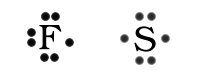
Fcl2 Lewis Structure ~ Notes4 Bonding. Review what a lewis dot diagram is and discover how to draw a lewis dot structural formula for compounds. Since they are in the same group on the periodic table they each have the same number of electrons their structures are similar. Determine the shape of the ion the central atom has two lone pairs and two bonding pairs (four. This problem has been solved! The cf 3 n + sf 3 isoelectronic isomer of cf 3 csf 3 (doi:
If we assume that you mean thallium then it is in group 3, meaning that we can assume three electrons in its outer shell. State the n, l, and ml values for these orbitals: Use the bond energy to calculate an approximate value of δh for the following reaction. Cf 3 csf 3 is a known crystal structure (doi: Switch the hydrogen atoms of water with fluorine atoms, and you get oxygen difluoride, a compound with slightly stronger oxidizing power compared to el.
Notes4 Bonding from donkistry.tripod.com Iron dichloride is an iron coordination entity. Now, we must figure out how many valence electrons total we would need. Nonzero formal charges are indicated for each atom in the structure once the total number of electrons is correct. State the n, l, and ml values for these orbitals: Use principles of atomic structure to answer each of the following: In the video on electronegativity we learned how to determine whether a covalent bond is polar or nonpolar in this video we're going to see how we can figure out whether molecules are polar or nonpolar and also how to apply that polarity to what we call intermolecular forces intermolecular forces are the forces that are between molecules and so that's different from an intramolecular force. Which is the more stable form of fno 2? Draw the lewis structure (electron dot diagram) and identify the central atom aluminium atom, al, is the central atom.
Review what a lewis dot diagram is and discover how to draw a lewis dot structural formula for compounds.
Fri sep 29, 2017 2:04 pm. It is used in sewage treatment, in dyeing of fabrics, and for many other uses. Here you have two groups of bonding electrons either side of a central atom in the carbon dioxide triatomic molecule producing a linear shape. In the video on electronegativity we learned how to determine whether a covalent bond is polar or nonpolar in this video we're going to see how we can figure out whether molecules are polar or nonpolar and also how to apply that polarity to what we call intermolecular forces intermolecular forces are the forces that are between molecules and so that's different from an intramolecular force. The four electron groups are the 2 single bonds to hydrogen and the 2 lone pairs of oxygen. A recommended procedure might be: Draw the lewis structure (electron dot diagram) and identify the central atom aluminium atom, al, is the central atom. According to june 2011 mark scheme it's linear. It turns out that there is indeed a substance that has stronger oxidation power than fluorine! Use principles of atomic structure to answer each of the following: The arsenic atom goes in the center of the lewis structure since it is the least electronegative atom. Full dot and cross electron structure. Chlorine is a potent irritant to the eyes, the upper respiratory tract, and lungs.
Sulfur being the less electronegative atom than chlorine atom is placed at the center in lewis's diagram and chlorine is spaced evenly around it. What is thegeometric shape formed by the atoms inicl 4 +? The single bond, formed from the sp2 orbitals, and πbond by parallel This problem has been solved! The arsenic atom goes in the center of the lewis structure since it is the least electronegative atom.
The Structures And Properties Of Halogen Bonds Involving Polyvalent Halogen In Complexes Of Fxo N X Cl Br N 0 3 Ch 3 Cn New Journal Of Chemistry Rsc Publishing Doi 10 1039 C3nj01015e from pubs.rsc.org Fri sep 29, 2017 2:04 pm. What is thegeometric shape formed by the atoms inicl 4 +? Determine the steric number (total number of electron pairs around the central aluminium atom) steric number is 3 determine the number of bonding pairs 3 bonding pairs of electrons around the central al atom. This problem has been solved! Scl2 lewis structure contains one sulfur and two chlorine atom. Ok so the first step is to find out how many valence electrons each atom has. No information is available on the carcinogenic effects of chlorine in humans from inhalation. Use the bond energy to calculate an approximate value of δh for the following reaction.
Draw the lewis structure (electron dot diagram) and identify the central atom aluminium atom, al, is the central atom.
Single, double & triple bonds. Chapter 5 / lesson 7. The sulfur atom here has two bonding pairs (shown as horizontal lines) and two lone pairs (shown as two dots for each pair). Here you have two groups of bonding electrons either side of a central atom in the carbon dioxide triatomic molecule producing a linear shape. Let us help you simplify your studying. In each case, name the element with the following. A recommended procedure might be: Based on the lewis structures in letter a, answer the followingquestions: Full dot and cross electron structure. There is two lone pair present on the central atom and this central atom attached to two bonded pair in scl2 lewis structure. Switch the hydrogen atoms of water with fluorine atoms, and you get oxygen difluoride, a compound with slightly stronger oxidizing power compared to el. According to june 2011 mark scheme it's linear. Scl2 lewis structure contains one sulfur and two chlorine atom.
In the video on electronegativity we learned how to determine whether a covalent bond is polar or nonpolar in this video we're going to see how we can figure out whether molecules are polar or nonpolar and also how to apply that polarity to what we call intermolecular forces intermolecular forces are the forces that are between molecules and so that's different from an intramolecular force. For the scl2 lewis structure use the periodic table to find the t. Chapter 5 / lesson 7. It is used in sewage treatment, in dyeing of fabrics, and for many other uses. Single, double & triple bonds.
Physical Science Bonds Flashcards Quizlet from quizlet.com State the n, l, and ml values for these orbitals: The x would be the number of atoms surrounding the central atom and e is the number of lone pairs around the central atom (a). 10.14469/ch/191823 lewis' 1916 representation of the triple bond in three isomeric. Use the bond energy to calculate an approximate value of δh for the following reaction. The molecular shape is bent, with a theoretical bond angle of 109.5°. The single bond, formed from the sp2 orbitals, and πbond by parallel Review what a lewis dot diagram is and discover how to draw a lewis dot structural formula for compounds. So starting off by drawing the lewis structure:
If we assume that you mean thallium then it is in group 3, meaning that we can assume three electrons in its outer shell.
Complete the following lewis structure by adding bonds (not atoms), and then indicate the longest bond: The single bond, formed from the sp2 orbitals, and πbond by parallel Based on the lewis structures in letter a, answer the followingquestions: Cf 3 csf 3 is a known crystal structure (doi: Here you have two groups of bonding electrons either side of a central atom in the carbon dioxide triatomic molecule producing a linear shape. Let us help you simplify your studying. There is two lone pair present on the central atom and this central atom attached to two bonded pair in scl2 lewis structure. Single, double & triple bonds. Review what a lewis dot diagram is and discover how to draw a lewis dot structural formula for compounds. So starting off by drawing the lewis structure: N m ml (all values) 4s 3d 5f 3. Which is the more stable form of fno 2? Draw the lewis structure (electron dot diagram) and identify the central atom aluminium atom, al, is the central atom.
If we assume that you mean thallium then it is in group 3, meaning that we can assume three electrons in its outer shell fcl. N m ml (all values) 4s 3d 5f 3.